
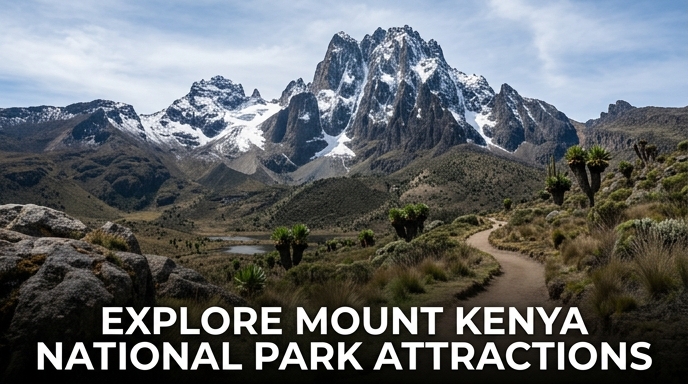
Mount Kenya National Park stands as a monumental testament to the beauty of the Kenyan Highlands. Dominating the skyline east of the Rift Valley, this imposing extinct volcano offers an unforgettable experience. Located 140 kilometers north-northeast of Nairobi, the northern flanks of the mountain cross the Equator, creating a unique geographical marvel.
Designated as a UNESCO World Heritage Site in 1997 and recognized globally as a Biosphere Reserve, Mount Kenya National Park covers 715 square kilometers. This protected area includes all ground above 3,200 meters, along with two lower salients extending to 2,450 meters along the Sirimon and Naro Moru tracks. Surrounding this core is the Mount Kenya National Reserve, adding 2,095 square kilometers to the ecosystem. The mountain serves as a vital water catchment area, supplying the Tana and Northern Ewaso Ngiro systems.
Towering Peaks and Geological Wonders
The true draw for visitors to Mount Kenya National Park is the chance to witness its breathtaking central peaks. The mountain features two main summits that challenge climbers: Batian, towering at 5,200 meters, and Nelion, which reaches 5,188 meters. These rock formations give way to ice and snow, creating a stunning contrast against the lower slopes.
Visitors will encounter a rich geological variety. The terrain transitions from higher forests and bamboo groves to alpine moorlands, shimmering lakes, tarns, and glaciers. You will also find glacial moraines and mineral springs scattered throughout the pristine wilderness, making the journey visually rewarding.
How to Reach the Mountain Routes
Planning your journey is relatively straightforward, with several access roads available depending on your preferred Mount Kenya climbing routes. Situated 175 kilometers from Nairobi, the park can be reached via the Nanyuki-Isiolo road if you take the Sirimon Track. Alternatively, travelers can use the Nyeri-Nanyuki road near Naro Moru.
For those approaching from the east, the park is reachable via Chogoria on the Embu-Meru road, about 150 kilometers north of Nairobi. If you prefer to fly, the closest commercial airstrip is located at Nanyuki.
Wildlife and Accommodation Facilities
A trip to the park offers excellent opportunities for mountain climbing and game viewing. High altitude adapted plains game and rare, endangered species roam the lower forests. To support visitors, the park maintains facilities ranging from basic shelters to comfortable lodges.
Mountaineers can utilize strategically placed huts like the Liki North, Minto’s, Austrian, and Judmare Huts. Mackinders Hut is managed by the Naro Moru Lodge, while Shiptons Hut is overseen by the Mountain Rock Hotel. For slightly more robust accommodations, the Sirimon Bandas and Warden’s Cottage provide excellent shelter. You can also book a stay at the Mountain Lodge, operated by Serena Hotels, or the Rutundu Fishes Lodge via Lets Go Travel.
African Alpine Vegetation and Ecological Zones
The flora and fauna vary dramatically with altitude, resulting in a display of unique montane and sub-alpine vegetation. Between 1,200 and 1,850 meters, the environment is dry upland forest featuring Croton. In drier lower zones below 2,500 meters, particularly along the western tracks where rainfall is 875 to 1,400 millimeters, Juniperus procera and Podocarpus dominate. Conversely, wetter areas receiving over 2,200 millimeters of rain feature Cassipourea malosana.
Elevations between 2,500 and 3,000 meters host a dense belt of Arundinaria alpina bamboo. Intermediate elevations showcase a mosaic of bamboo and Podocarpus milanjianus. In maximum rainfall zones, receiving up to 2,400 millimeters annually, Hagenia abyssinica and Hagenia revolutum dominate.
Above 3,000 meters, tree stature declines, replacing Podocarpus with Hypericum species festooned with mosses. The high altitude heath zone features African sage, Protea, and Helicrysum. Continuing upward, the lower alpine moorland zone is defined by high rainfall, thick humus, tussock grasses like Festuca pilgeri, and sedges. Here, you will spot Alchemilla cyclophylla and Geranium vagans.
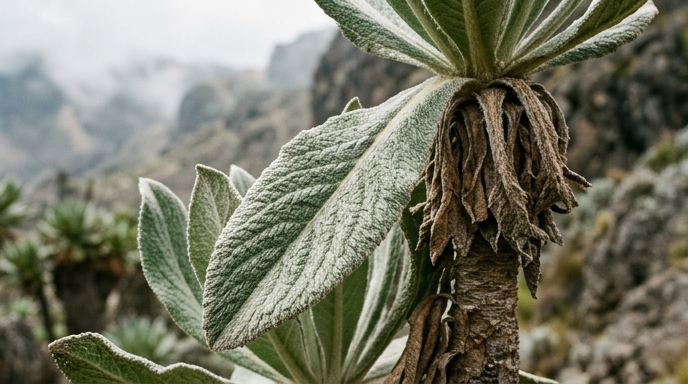
The upper alpine zone, reaching 4,500 meters, houses bizarre giant rosette plants such as Lobelia telekii, Senecio keniodendron, and Carduus. Continuous vegetation stops at 4,500 meters, though isolated vascular plants survive over 5,000 meters. Historical records by Hedberg in 1951 note 13 species of endemic plants strictly unique to this environment.
Frequently Asked Questions
What are the main peaks in the park?
The mountain features two primary summits that dominate the skyline. Batian is the highest point at 5,200 meters, closely followed by Nelion at 5,188 meters, both offering challenging terrain.
What types of accommodation are available inside the park?
Visitors can choose from high-altitude mountain huts like Mackinders and Shiptons, to the Sirimon Bandas, and comfortable private lodges such as the Serena Hotels’ Mountain Lodge.
Which entry gates provide access to the mountain?
You can access the park through three main routes. These include the Sirimon Track, the Naro Moru route, and the Chogoria route located on the Embu-Meru road.
Exploring a Kenyan Natural Treasure
Visiting Mount Kenya National Park offers a profound connection with one of East Africa’s most diverse ecosystems. From dense bamboo forests to sweeping glacial valleys, every elevation reveals an entirely new layer of ecological wonder. Whether you aim to conquer the towering summit of Batian or simply enjoy the rare high-altitude flora, this UNESCO-protected environment guarantees an extraordinary adventure. Careful preservation of its pristine wilderness ensures that future generations of travelers can continue to marvel at its immense beauty.